
the grace of making in dark time
Hello friends, familiar and new, and welcome to a house in a hamlet in a forest in Finistère. I’m Jan and I hold spaces for those on journeys of transformation. I believe story is powerful and that the earth offers healing through our daily connection and herbal allies. My Sunday posts are always free and you are so welcome here. Let’s create a little alchemy together.

The forest is talking of Spring. In the cycles of the year, we’re in blossom season — this from the first full year in the forest, when I was learning their tongues, as I still am:
April 18-22
Orchard blossoms pink.
Bees, fat with pollen, savour
warm days’ nectar.
It seems increasingly miraculous that despite the havoc we have wreaked on the earth, the earth still holds us. Not without surprises. We had almost two months of rain here at the start of the year and many of areas of France were devastated by floods. We know that forest fires will rage again this year, that storms are more frequent and wilder, that in some places false springs nudge trees to leaf too soon, causing collapse later… Yet still, the sun rises. Still the blossom is pink. Still the pollinators, those we haven’t killed with chemical fertilisers and other tactics of mass destruction, do the work that allows us to eat. Still the herbs appear despite the shattered ground:
Last year, on a tiny patch of scrubby ground at the entrance to the forest, a little enclave of flowers appeared overnight. A profusion of borage, meadowsweet, and magically, one tall yellow evening primrose. After the October storms, the patch was devastated by heavy machinery that went in to extract fallen trees. I thought there would be no growth this year, the ground churned and compacted. But late in the Summer a single evening primrose springs up… then more and more. A vulnerable-looking flower rising from a small patch of traumatised ground.
from, At the Heart’s Farthest Edge
And equally miraculous that despite the dire state of our political and social institutions, despite the reigns of terror, still there are countless acts of human compassion and courage. Still there are communities that refuse to give in to tactics of hatred and division. Communities that pick up the sentiments of Camus in The Myth of Sisyphus, who felt life was absurd, but found meaning in the struggle. Communities that echo W. H. Auden’s poem of what truly matters:
September 1, 1939
All I have is a voice
To undo the folded lie,
The romantic lie in the brain
Of the sensual man-in-the-street
And the lie of Authority
Whose buildings grope the sky:
There is no such thing as the State
And no one exists alone;
Hunger allows no choice
To the citizen or the police;
We must love one another or die.
When the world is broken we need radical acts. Some of these may make us vulnerable to the powers that be, some will be quiet acts of resistance and community that are just as powerful.
In a world of busyness and expectations of inhuman productivity, rest and listening to our fragile bodies are radical acts.
In a world that places value on people according to gender, ableism, race… it is a radical act to refuse to other anyone.
In a world bent on destroying the animate world that nurtures us, it is a radical act to slow down, pause, pay deep attention.
July 2016, I find myself at a two-day workshop on narrative in film-making at Ealing Studios, London. My son, who had done his degree in film production and moved on the an MA in writing, had booked, but was unable to attend so I went in his place to bring back notes and insights. It was a fascinating weekend run by Guerrilla Films, but the highlight was when an enthusiastic lecturer from another course burst into the room to anounce an opportunity to walk on broken glass. He was using this as a metaphor for the course he was teaching. A rich image not only of brokenness, but how we navigate it.
It was not something I’d ever imagined doing. And I went first. There were no instructions, but my body knew how to move, how to pace, how to find the rhythm. My body knew that sharp, fast movements would cut. That ultra-slow dithering would sink my weight into the shards.
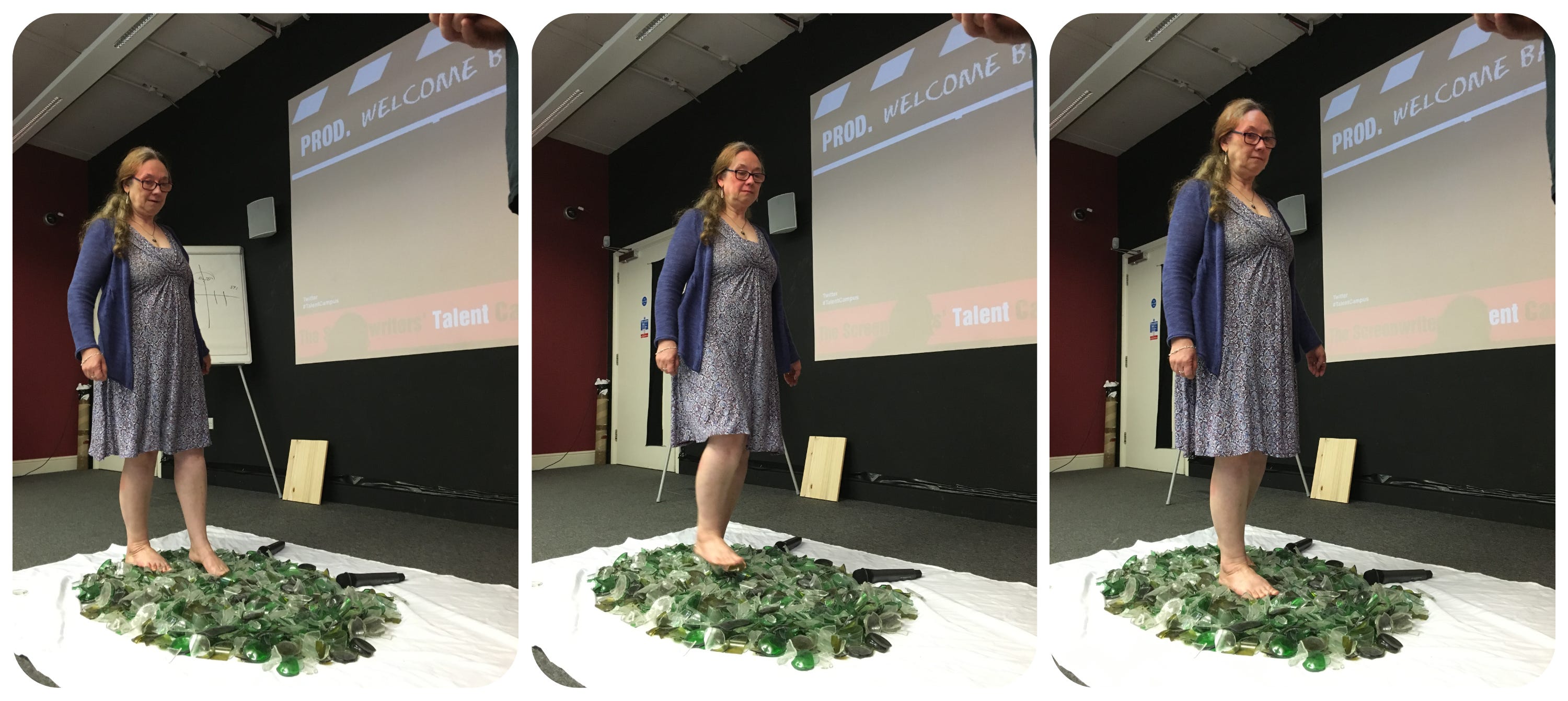
Here we are walking through a world of broken glass. And we can do it. Not alone. I would never have managed this alone. It happened in a community that had formed quickly with a talented tutor. It happened in an atmosphere of good will and quiet encouragement. A body among bodies.
There was no guarantee of safety — there never is. But there were repeated moments of triumph, several of the group saying something deeply moving about the symbolism in their own stories. We knew what we were negotiating and we walked on. Sisyphus begins again, no matter how absurd the task feels, because the meaning is made in that moment.
There’s a scene in the TV series, Angel, which I watched with my teenaged children years ago, when the world is ending, though not eveyone realises it. One of the characters visits a friend who runs a homeless shelter and she asks for help bringing in new supplies of food and blankets. He asks what she would do if she knew this was the world’s last day and she says, she’d bring in the blankets, make the soup, listen to the stories of the lonely. This is meaning.
In any time it is a radical act to make art that invites us to find meaning. In the time we inhabit, it’s an act of deep resistance. Like walking on broken glass, when we make, when we write, when we witness, we know what we’re navigating and still we go on. We are not paralysed. We are not stopped in our tracks.
Art of all kinds — playful, creative, symbolic, reportage, memoir, poetry… art, whether plastic or written or… is a way of making narrative meaning in an absurd time. Art has the capacity to raise the stuff of life to significance.
In stressful times it’s so easy to fall into overwhelm. How many of us fall asleep with a loop of ‘What if…?’ playing in our minds? What could have been, what should have been, what might happen if… 2am and 3am counterfactuals circling… Do you find yourself there?
But we know that none of this over-thinking will give us certainty. I’m never going to switch off my rationalising, problem-solving self, but what really connects me to others is narrative thinking. The story of who we are, who we become… the witness to this strange, beautiful, terrible world is where resistance and possibility and togetherness live.